
Cor Ardens
By Joel S. Dryer


Click to view full image
Cor Ardens exhibit at Arts Club of Chicago

Click to view full image
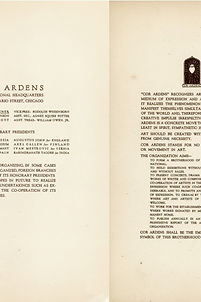
Cor Ardens exhibition pamphlet


Cor Ardens (1921-1924)
Founding of the Novel Organization
The Cor Ardens or “Ardent Hearts” movement was a short-lived but historically significant international brotherhood of artists founded in Chicago in 1921. The name was suggested by the Russian Theosophist artist Nicholas Roerich (1874–1947) on a visit to Chicago in April of that year.[1]
Organization Aims
First: To form a brotherhood of artists which is international;
Second: To hold exhibitions without juries, without prizes and without sales;
Third: To create centers where art and artists of all countries will be welcome;
Fourth: To work for the establishment of universal museums where works donated by members may have a permanent home.[2]
Germination of the Idea
The idea for Cor Ardens grew out of the successful Salon des Refusés exhibition that Raymond Jonson, Carl Hoeckner, and Rudolph Weisenborn organized in 1921 at Rothchild’s department store, which featured nearly 300 works that had been rejected by or were independent of the established annual exhibition of Chicago artists at the Art Institute of Chicago; the artists were seeking an alternative to the conservative Chicago art scene.[3]
Raymond Jonson (1891–1982), who would later become a founder of the Transcendental Painting Group and relocate in New Mexico, was the initial President when the organization was officially established in July 1921. Roerich was appointed Honorary President for the Russian division as the organization expanded its international affiliations.[4]
Chicago Tribune critic Eleanor Jewett reflected on the emergence of the new artistic society. What first appeared to be a mere group of like-minded individuals soon revealed itself as something more ambitious: the budding form of an artistic socialistic society whose founders hoped its ideals would one day find a home in every corner of the world.[5]
Critical Review
Jewett introduced the organization by weaving her own commentary around a letter she had received from the organization announcing its creation. The letter opened with a clear sense of purpose: “Enclosed I am sending you the preamble and constitution of the recently founded international artists’ organization, Cor Ardens.” From its inception earlier in the year, a few Chicago artists sought to establish a fellowship rooted in shared artistic ideals. According to the letter, Roerich lent “the greatest encouragement,” affirming that similar artistic aspirations were present in London, Paris, and other world art centers. His enthusiasm led him not only to join the organization but to take an active role in communicating with sympathetic artists around the globe.
Membership
Membership, as Jewett noted, was intended for “architects, composers, writers, poets, painters, sculptors, and graphic artists,” underscoring the society’s inclusivity across disciplines. The letter articulated the group’s philosophical basis: “Cor Ardens recognizes art as the universal medium of expression and evidence of life. And that artistic ideals manifest everywhere simultaneously, transcending heritage; thus, artistic creation should arise from an “honest mind and from genuine necessity.” Jewett paused here, subtly questioning what such “genuine necessity” might truly mean, hinting that this lofty phrase may conceal more ambiguity than clarity.
The letter described Cor Ardens as an effort “to bring together, at least in spirit, sympathetic, isolated individuals,” uniting them along a “rising road of grandeur, enthusiasm, and achievement with all the powers of our spirit.” Here Jewett’s commentary grew gently ironic. She noted that the combination of holding exhibitions with no sales while simultaneously collecting works for permanent museums seemed almost comically convenient—particularly for those seeking a respectable alternative to having unsold canvases clutter their homes “until the blowing of Gabriel’s horn.” Similarly, the solemn assertion that art should arise from “genuine necessity” prompted Jewett to reflect on the realities of the artist’s life. “If necessity is the measure” she mused, then pot-boilers—those artworks produced purely for income—surely met the requirement, born as were from the urgent need to “keep the wolf from the door and the bill collector at least partially appeased.”
Through this blending of quoted idealism and pointed commentary, Jewett presented Cor Ardens as both earnest and slightly quixotic—an organization rooted in noble artistic aspirations yet shadowed by the practical contradictions that inevitably accompanied any utopian endeavor. Her essay honored the sincerity of the founders’ vision while reminding readers of the ever-present tension between artistic purity and the realities of the working artist.
Honorary presidents were named for various countries including Maurice Maeterlinck for Belgium; Gerhart Hauptmann for Germany; Ignacio Zuloaga for Spain; Augustus John for England; Axel Gallen for Finland; Ivan Mestrovic for Serbia, and Rabindranath Tagore for India.[6]
First Cor Ardens Exhibition
Their first exhibition was hosted by the Arts Club of Chicago in November 1922, with a planned tour of the exhibition to a few other cities. The submissions by artists were not subject to a jury system, and each artist was represented by one work encompassing thirty-five paintings and three sculpture – twenty-three by Chicago artists.[7] One review of the exhibit stated: “Frankly, the thirty-five pictures are individualistic. Each artist paints in his own way. Many styles of technique, from the primitives thru the conservatives to the cubistic arrangement of planes and the so-called ‘modernist’ fashion of composition, are shown.”[8] Eleanor Jewett’s comment however was a bit more biting in saying: “The freedom of style and treatment allowed makes the exhibition an original one, to some intents, but a weak one when you realize how bitterly bound these artists are by their efforts toward freedom.”[9] The exhibition then traveled to the Milwaukee Art Museum the following month.[10] By the end of the second season forty members had paid dues to participate in the group.
Closure
There was another smaller exhibition under the auspices of the Renaissance Society in Chicago but none followed that, for unknown reasons.[11] We may surmise that the founding of the Chicago No-Jury Society of Artists fulfilled many of the purposes they had sought with Cor Ardens.
[1]C. J. Bulliet, “Artists Past and Present - Carl Hoeckner 1883-1972,” Chicago Daily News, 7/10/1937. Roerich was given credit for starting the organization in Jacob Zavel Jacobsen, Thirty-Five Saints and Emil Armin, (Chicago: L.M. Stein, 1929), p.101. The Latin translation reflected their idealistic and spiritual aims.
[2] “COR ARDENS,” Wave, February 1922, Vol. 1, No. 2, pp.33-34.
[3] Critic Sam Putnam gave Roerich credit for organizing the group in “Nicholas Roerich- a Few Impressions,” The Chicago Evening Post Magazine of the Art World, 11/18/1924, p.8. As to its organization see also: Blanche C. Matthias, “Cor Ardens,” Chicago Herald and Examiner, 11/12/1922.
[4] The following year they reorganized the leadership including President Carl Hoeckner; Secretary Raymond Jonson; Treasurer Rudolph Weisenborn; Vice President Raymond Shiva and Assistant Secretary Agnes Squire Potter. “Cor Ardens” in “News of the Art World,” Chicago Evening Post, 8/30/1921, p.9, The Cor Ardens letterhead from 1922-1923 shows the changes in leadership. Originally Jonson was president, and other officers changed positions, but the artists remained the same.
[5] Eleanor Jewett, “Art and Architecture,” Chicago Tribune, 8/7/1921, part 8, p.4.
[6]Letter to Carl Hoeckner from Augustus John, no date, c.1922, IHAP Library. For more information on the organization see: Blanche C. Matthias, “Cor Ardens,” Chicago Herald and Examiner, 11/12/1922.
[7] Letter to Fellow Members of Cor Ardens announcing the first exhibition from Agnes Potter, secretary, 8/9/1922. Exhibition Of Paintings And Sculpture By American Cor Ardens, (Chicago: Arts Club of Chicago, 11/16/1922).
[8] The show was only briefly reviewed as “individualistic” because the critic felt that the stated purposes of the organization against standards would not call for any further in-depth comment on the works. Lena M. McCauley, “The Cor Ardens,” in “News of the Art World,” Chicago Evening Post, 11/28/1922, p.11. See also a letter from Raymond Jonson to Mrs. M. J. Sparks, IHAP Library, 5/5/70.
[9] Eleanor Jewett, “Art and Artists,” Chicago Tribune, 12/3/1922, part 7, p.12
[10] “Cor Ardens Will Exhibit at Institute,” Milwaukee Journal, 12/3/1922. J.K., "Cor Ardens' Varied Work Shown Here," Milwaukee Journal, December 17, 1922.
[11] Marguerite B. Williams, “Art Notes,” Chicago Daily News, 5/21/1924 in Art Institute of Chicago scrapbooks, vol. 48.