
Chicago Society of Artists
By Joel S. Dryer

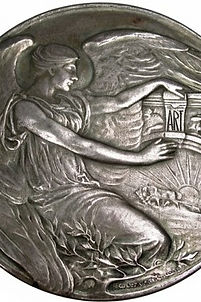
Click to view full image
Chicago Society of Artists Silver Medal


Click to view full image
Silver Medal, Chicago Society of Artists 1922


Chicago Society of Artists
The Chicago Society of Artists was formed on November 19, 1887. Limited to men only, as was customary in art societies of the day, eleven local artists formed the first body of members with landscape painter Henry Fenton Spread (1844-1890) elected as their President.[1] Their first meetings were held in Spread’s studio in the Lakeside Building,[2] Artists became members upon sponsorship by two other members and presentation of examples of their work to a committee on membership; three negative votes would preclude membership.[3] Proposed members were to be gentlemen of good social standing.
Early Formation and Founding (1887)
The CSA had professional and non-professional members; the latter consisting of some of Chicago’s wealthiest art patrons, as well as William M. R. French and Charles L. Hutchinson, the two men responsible for running the Art Institute of Chicago. “Among their members are men who have had excellent opportunities abroad, not only in handling the brush but in acquiring a familiarity with the literature of the craft.”[4] On Saturday evenings members met for the study, criticism, and entertainment: “These culture evenings consist of essays on themes congenial to the members, with discussion following the readings, and with pleasant music numbers alternating with the other features of the program.[5] As funds became available, they expanded life drawing classes to nights during the week.[6] On the third Thursday of each month a general' meeting was held, which entailed an essay or lecture by a member, followed by discussion and later some entertainment such as music.[7]
First Exhibitions and Early Growth
Their first annual show of ninety-three works opened on February 9, 1889, in the studio rooms they had rented above C. Hennecke and Company at 207 Wabash Avenue. Hennecke were dealers in statuary for use in learning figure drawing and decoration and were the authorized dealer of plaster casts relating to President Lincoln, such as life masks, executed by artist Leonard Wells Volk (1828-1895).[8] The exhibition catalog stated:
On the 19th of November, 1887, eleven artists met at the studio of one of the number, to consider the project of forming a society of Chicago artists. Undismayed by the record of failure that has attended previous attempts in a similar direction in this city, it was unanimously resolved to make another effort to effect an organization that should bring Chicago artists into closer fellowship with each other, that should stimulate artistic energy and healthy rivalry among its members, and if possible, produce that harmony and good feeling between them and the Chicago public which is so necessary to the permanent advancement of local art. The Chicago Society of Artists is the result of that meeting, and the record of its short life of fourteen months is one of continued harmony and steady growth. From eleven, the professional membership has increased to thirty-nine. The non-professional membership, as will be seen by reference to the list in the latter part of this book, is very much greater.
These facts, together with the large attendance at the regular Saturday evening meetings of the Society, where regular and associate members meet for the purpose of study, criticism and general discussion, denote the degree of interest taken in our work. On the third Thursday of each month a general meeting of the Society is held, to which all members (regular, associate and annual) are invited. The program at these meetings consists of an essay or lecture by some member of the Society, on some subject connected with art study, followed by an open discussion by all who wish to participate, also music and such other entertainment as the committee may provide. The Society proposes to have one annual and principal exhibition of the works of Chicago artists, and as many supplementary exhibitions as may be found practicable each year, and to further the interests of art in Chicago by every means in its power. All who are interested in the objects stated, and would like to identify themselves with this movement are cordially invited to communicate with the Society.[9]
Garnering a mixed review in the Chicago Tribune, the critic praised some works but chided the artists as living in a world of “mutual admiration” resulting in art that was accepted into the show, but not up to “standards.” [10]
Efforts were made to raise funds by leveraging the talents of the members. In April 1889 a calendar, with illustrations from both member and local non-member artists, was proposed. The lucky few whose works were used in the calendar would be paid twenty-five dollars as well as a share in the sale profits.[11]
The artists held several “sketch sales” for smaller oil paintings and watercolors, the first of which was in October 1889. Half of the proceeds went to the artist and the other half into the club treasury.[12] Some years later columnist William Vernon suggested these sales had a humorous side:
“The sales were sort of mock auctions, and one of the funniest and drollest members (usually Walter Burridge) acted in the capacity of auctioneer. The money realized from these sales went to pay the running expenses of the club and if there happened to be any left over it was used for an especially elaborate repast on the following Saturday night and a fresh supply of tobacco and corncob pipes.”
The first annual holiday sale was opened on December 7, 1889. By then group had “newly furnished and tastefully decorated” their rooms Hennecke’s with the hopes of expanding their fledgling organization. A review by the Tribune critic was decidedly more favorable than the harsh criticism of their first annual exhibit earlier in the year. Some works were called “clever interpretations” or “beautiful” and “well rendered.”[13]
Now comprising some forty members, and continued support from wealthy local patrons, the club opened their second annual exhibition at the Art Institute on April 2, 1890, held concurrently with the eighth annual exhibit by the women’s Palette Club. The reviewer for the Inter Ocean was particularly harsh. While noting over eight hundred visitors attended opening night, he said that “If it were not for some of the new men…even the possibly good pictures would stand out in an arid waste of paint as lonesome monuments of what might have been.”[14]
One artist, Arthur Bowen Davies (1862-1928), who would later come to international fame, and who organized the International Exhibition of Modern Art in 1913 – otherwise known as the Armory Show – exhibited four works, only one of which the critic found satisfactory. Three days later, presumably the same reviewer, stated: “The artist is a lazy animal, and those of Chicago as a class form no exception.”[15] He skewered The Finishing Touch by Oliver Dennett Grover (1861-1927), which today is a highly respected painting the Swope Museum collection.
Another critic, however, called the show “the finest collection of works ever exhibited in Chicago.”[16] The Tribune offered that, “Both of the clubs make a good showing and give good evidence of careful and conscientious work during the year.”[17]
As the club was readying new quarters on the top floor of the Chicago Athenaeum, which was directly behind the Art Institute,[18] they moved into temporary space shared with the Chicago Architectural Sketch Club within the Art Institute, and in October 1890, they held their third annual sketch sale. This exhibit differed from the two earlier fund-raising sales in that if featured predominantly finished oil paintings.[19]
With the move to new quarters, they raised funds from two of the founders of the Art Institute, James Dole, and Charles Hutchinson.[20] A sum of $1,000 was expended to decorate the new rooms about $30,000 in today’s money, that included velvet curtains, oriental rugs, polished furniture, and gas jet lighting. Skylights and a separate room for drawing from live models were also features of the new space.[21] Shortly after the death of founding president Mr. Spread, John Laurie Wallace (1864-1953) was elected to the post, however shortly after his election, he left to assume the role of director of the Academy of Fine Arts in Omaha.[22]
In April 1891, the club opened its third annual exhibition, in the splendidly decorated Athenaeum rooms, with John Henry Vanderpoel (1857-1911) elected the new President. While not members, five women were offered slots in the exhibition.[23] The Inter Ocean critic who had been so harsh in reviewing the first two exhibitions, tempered his acidity and praised a great number of works, while criticizing the more seasoned painters with some “potboiling” or offering works that took little effort or time.[24] The Tribune had this to say, “The galleries were filled with an interested throng of admirers of art. They were unanimous in pronouncing the collection shown the best exhibition of work of local artists ever shown in the city.”[25]
Critic Teresa H. Dean of The Herald noted a significant increase in the quality of works suggesting it was because of the stringent jury who had rejected almost twice as many paintings as they had accepted. Ms. Dean’s criticism spanned an entire page replete with numerous illustrations and thoughtful commentary. She would later be considered the first female war correspondent for stories on the Spanish-American War, the Boxer Rebellion in China, and insurrections in the Philippines, Mexico, and Cuba.[26]
With the closing of the exhibition in May, members decided to keep a permanent exhibition on the walls, with changes from time to time selected by a jury, in effect an art museum of local artists’ works.[27] The club was now thriving and offered classes in drawing from life models three days a week. Only the School of the Art Institute offered such a schedule, and only to its tuition paying students.[28] Members once again showed their strength to favorable reviews with the fourth annual sketch sale. This was comprised of finished oil paintings, not sketches, and watercolors. [29]
The annual fundraiser, through auction, was now a regular fixture of the club’s schedule, and accorded a great deal of respect by the press. One article stated, “The standard of work shown is higher than ever before and there will doubtless be some sharp bidding for some of the works.”[30] The quality of work was reflected in the fact that the receipts from the auction were “considerably more than on previous years.”[31]
The club held the first of their holiday exhibitions on December 7, 1891, but the planning, coming so soon after the close of the fall exhibition, was hurried to attract buyers for the gift-giving season. Invitations to artists to submit their works were made on short notice, and although the quality of works was on par with previous exhibits, the size of the show suffered as there wasn’t enough time to prepare paintings for exhibition.[32] Despite the scaled-down effort, there were several sales.[33]
As 1892 opened the artists began to question the need for regular art classes, which had proven quite expensive. The full members were well-established artists and not taking any classes while it was the Associate members who were frequenting the opportunity for free instruction. As the Art Institute was next door, it was thought a better idea to close instruction at the Society.[34]
Charles Tyson Yerkes Prizes
Later that year rail magnate Charles Tyson Yerkes offered a first prize of $300 and second prize of $200 for the annual exhibition open to all artists providing the painting did not represent the “impressionist” mode and the artist was a Chicago resident.[35] The residency requirement however was the beginning of trouble. While the prize was open to members and nonmembers alike, those of the Cosmopolitan Art Club, many who had already broken away from the Society in April of 1892 saw the restrictions to resident artists as an undue discrimination. Animosity grew when “John H. Vanderpoel, the President of the Society of Artists, and Director French of the Art Institute had conferred with Mr. Yerkes in regard to eligibility for the prizes and it was decided that competitors should be residents of at least one year's standing."[36]
Most Cosmopolitan club members, as newcomers or non-residents of Chicago, considered the policy unwarranted. The newspapers disagreed, “In fact the requirement of a year’s residence in the city is most reasonable, otherwise any stranger could reside here for a week and call himself a Chicago Artist."[37] This proved to be great lack of foresight. Most of the founders of the Cosmopolitan club became Chicago’s longest residents and most influential artists such as Charles Francis Browne and Frank Charles Peyraud.
Challenges and Organizational Changes (1890s–1902)
During the exhibition of April 1892 there was a fire which destroyed the exhibition and the club rooms on the top floor of the Athenaeum Building. There was no insurance on the pictures, all records were destroyed and the club rooms gutted.[38] The $300 and $200 Yerkes prizes were not given due to the fire. More trouble was at hand when most of the Society members voted to hold another exhibition at the Stevens Gallery in May and award the Yerkes prizes then. The landscape artists complained this was unfair since only portrait and figure painters could gather materials for painting in the short period of time between the April fire and the proposed May exhibition. At this juncture, more members from the Society broke off to join the Cosmopolitan. The Cosmopolitan passed a resolution that no member could maintain concurrent membership in the Chicago Society of Artists after sending written invitations to join to the members of the Society.[39]
By 1893 the Society was having discussions with other organizations including the Palette Club, Architectural Sketch Club and even the Cosmopolitan Art Club to combine organizations into one for purposes of exhibition and commerce. In 1894, the Architectural Sketch Club leased space in concert with the Society in a building at 274 Michigan Avenue, although the Architectural club held exhibitions at the Art Institute.[40]
In 1895 and 1896 a joint exhibition was held among many of the city’s art organizations. The Chicago Society of Artists did not formally participate but several of its members submitted works to the exhibition. Agreeable terms still could not be reached on a joint exhibition between the clubs. Additional pressures for joint exhibitions came from the many women’s civic organizations who considered the exhibition of art a cultural matter and well within their purview. They were vying for exhibition of artist works and in effect working against each other and the artist’s organizations by attracting exhibitors with the promise of prizes and purchases. The last annual exhibition of the Society was in 1896.[41]
In 1897 the club disbanded.[42] Later that year the artist clubs and various civic and ladies’ organizations came under the influence of Art Institute teacher and the last president of the Chicago Society of Artists, John H. Vanderpoel, and William H. French, Director of the Art Institute. The Chicago Art Association was organized as an umbrella group for all the various non-artist clubs, and it was decided each organization would have various receiving days which they could call their own during the term of joint exhibitions. With this agreement the Art Institute of Chicago sponsored an exhibition with a jury consisting of an equal number of members from the Palette Club, Chicago Society of Artists, Cosmopolitan Club and those unaffiliated with any club.[43]
Unfortunately, the Cosmopolitan Art Club would not agree to the terms proposed for holding the joint exhibition. The executive committee of the Art Institute then decided to forgo a joint exhibition in favor of a general exhibition of art by artists from Chicago and surrounding suburbs.[44] This was the beginning of the Art Institute’s annual Chicago Artists exhibitions which evolved into the annual Chicago & Vicinity exhibitions.
The first exhibition was held from January 26 to February 21, 1897, and was open to artists with the condition “exhibitors must be artists residing in Chicago, or in such relation thereto that their professional interests are centered there. Temporary absence will not disqualify."[45] Jurors for the shows for succeeding years came from a list of those artists accepted in previous shows. As prizes were at a maximum for the best works at these exhibitions Chicago artists often withheld their best works from all other exhibitions including the annual show by American artists at the Art Institute.[46] Without need for their own exhibitions or art classes, the disbanding of the Society was an appropriate move.
Revival and Silver Medal Era
During the week of April 1, 1902, a new Chicago Society of Artists was established, initially calling itself the Arts Club.[47] Formed in the studio of Ralph Elmer Clarkson, the group elected Oliver D. Grover as its first president.[48] Fifty artists made up the charter membership, and the club was briefly housed in the Fine Arts Building. One newspaper critic noted that its formation effectively revived the former Cosmopolitan Art Club and the ladies’ Palette Club, and in some ways, this was accurate, since distinctions between male and female, and between local and foreign artists, were removed to welcome all artists connected with Chicago.[49]
In April 1903, the name of the club was officially changed to the Chicago Society of Artists from the Arts Club. The new society continued to grow: “A little over twenty years ago a new Chicago Society of Artists came into existence which has continued to grow until its influence has become one of the greatest in the city."[50] The Society decided to honor its own with the Silver Medal given at the annual Art Institute exhibitions of Chicago and Vicinity artists. It was awarded first to John C. Johansen in 1904. “The award of the medal of the Chicago Society of Artists represents the highest honor that can be paid by that organization to a fellow painter or sculptor."[51] The medal was designed by Julia Bracken Wendt.
Earlier in 1903 it had been established that only artists who had exhibited within the prior five years were eligible to both vote and be voted upon for a place on the forthcoming jury for the Chicago and Vicinity show. In 1906, only members of the Chicago Society of Artists could vote and an artist could not serve more than twice in succession.[52] The year of that decision the Art Institute of Chicago gave the Society space in the basement of the museum for clubrooms.[53] Separate exhibitions outside of the Chicago and Vicinity shows, for club members only, reemerged as early as November 1906 with a “Thumb Box Exhibition"[54] and in 1914 began a series of major painting exhibitions that were sporadic.
Influence on Chicago Exhibition
A newspaper article in 1907 claimed the annual exhibition of Chicago & Vicinity artists was really an exhibition of the Chicago Society of Artists and its “associates."[55] That same year, the Society instituted the practice of soliciting purchase moneys from businessmen for works which would be chosen for them without their prior viewing, leaving it to a group of artists to make a selection in a given subscribed price range. This practice of solicitation, although successful (in 1908, it caused the sale of over forty paintings),[56] resulted in several members resigning in indignation at begging for what they viewed was “charity."[57]
For the 1909 Chicago and Vicinity show, the term “Vicinity” was actually enforced and no artist residing outside of fifty miles from Chicago could be admitted to the juried exhibition. This was in an effort to create a truly local encouragement of art.[58] The Chicago Society of Artists exerted strong control of the annual Chicago & Vicinity show through the selection of jurors from its members and control of exhibitions at the Art Institute: “The artists have always insisted that there should be no other exhibitions [at the Art Institute] at the same time."[59] The tone of this quotation shows a marked involvement by the Society in the activities of the museum in putting on this exhibition.
In 1910, the Art Institute of Chicago gave space to a permanent gallery of paintings selected from the best of the works by the artists exhibited in the annual Chicago & Vicinity shows.[60] Many of the Society’s recent accomplishments were lauded in the newspaper.[61] The Society grew impatient, however, with the restrictions of the “permanent gallery” at the Art Institute and sought to form a partnership with a commercial gallery where they could accomplish annual exhibitions, sales from these exhibitions and rotating works of member artists for sale on a regular basis; the last criteria would not be acceded to by the Art Institute.
In January 1911, just weeks before the opening of the Chicago and Vicinity show, the Society opened an exhibit by members at the Kelly Brothers American Art Galleries consisting of one hundred paintings, not more than two from each artist.[62] These same artists then participated in the annual Chicago and Vicinity show at the Institute beginning on 31 January.[63] Matters pretty much proceeded along with separate Society shows from time to time and broad participation in the annual shows at the Art Institute of Chicago and Vicinity artists.
Revolt of the Younger Artists and Split of the Older Artists
In May 1922, several younger and more modern leaning artists began to fight against a proposed change in the selection of juries and hanging of pictures at the annual exhibition. Sculptor Emil Zettler and painters Carl Hoeckner and Gordon Saint Clair distributed a circular among Society members calling for rescinding the proposed changes. They were concerned the reduction in jurors as well as the ineligibility after a year’s service would restrict the amount and type of art accepted into the show. Of the five points recommended for changes in the system, the younger group only agreed with one, that ballots be secret.[64] Secret balloting was installed for the next exhibition in 1923.[65]
The Society’s influence, which had resurged shortly after the turn of the century, lasted until 1923 when there came a split as the more radical painters gained voting control of the board and most of the conservative artists resigned to form the Association of Chicago Painters and Sculptors.[66] The more radical faction dominated the Society and succeeded in later operating the America Fore Gallery to show member’s works. In 1924, the Art Institute of Chicago changed their policy for selection of jurors due to the acrimonious infighting.
Respected collectors, non-artists, and a few unaffiliated painters were chosen to serve on the jury. Consequently, the Chicago Society of Artists, which for nearly three decades had overseen the annual exhibitions of Chicago painters, lost its influence over the show. Soon after, on March 24, 1924, the Society launched its “first” independent annual exhibition, held separately from the Art Institute, in the Marshall Field and Company Galleries.[67] The final distinguished Silver Medal was awarded in 1925 at the annual exhibition of Chicago artists, after which it was transferred to the Society’s own yearly shows.[68] For twenty years, the honor had consistently gone to the most outstanding painting displayed.[69] The artists continued to hold annual exhibitions, and the Chicago Society of Artists still exists today, though now as a loosely connected group whose original purpose is not entirely defined.
[1]Chicago Society of Artists First Annual Exhibition, (Chicago: Chicago Society of Artists, 3/24/1889). See also: “Present Status of Art Life in Chicago,” America, Vol. 5, 12/11/1890, p.297. “Art Matters in Chicago,” Chicago Tribune, 12/30/1888, p.17.
[2]“Society of Artists,” Chicago Evening Post, 3/13/1891, Art Institute of Chicago Scrapbooks, Vol. 5, p.34. A list of regular members appears at the end of the article.
[3]Op. cit., Chicago Evening Post, 3/13/1891, in AIC Scrapbooks, Vol. 5, p.34.
[4]“Art Notes,” Chicago Sunday Tribune, 1/20/1889, 28.
[5]Chicago Sunday Tribune, 1/20/1889, 28. James William Pattison, “Art Institutions in Chicago,” Jacksonville Journal, 1/14/1894 in AIC Scrapbooks, Vol. 5, p.140.
[6]“Art Notes,” Sunday Inter Ocean, Vol. XX, No. 47, 5/10/1891, Part 2, p.9.
[7]Chicago Society of Artists First Annual Exhibition, (Chicago: Chicago Society of Artists, 3/24/1889). See also: “Present Status of Art Life in Chicago,” America, Vol. 5, 12/11/1890, p.297. “Art Matters in Chicago,” Chicago Tribune, 12/30/1888, p.17.
[8]The Lincoln Life Mask, Hands, Bust and Statuette, (Milwaukee and Chicago: C. Hennecke Co., 1891).
[9]Op. cit., Chicago Society of Artists First Annual Exhibition.
[10]“The Artists’ Society,” Chicago Tribune, 2/17/1889, p.3.
[11]“Local Notes,” Sunday Chicago Herald, 4/7/1889, p.27.
[12]“The Works Of Young Artists,” Chicago Tribune, 10/20/1889, p.3. “Pencil And Brush: Chicago Society of Artists: Its Annual Sale of Pictures...,” Chicago Evening Post, 10/2/1890, p.5. “Art Notes,” Inter Ocean, Vol. XiX, No. 215, 10/26/1890, p.16.
[13]“Notes On Current Art,” Chicago Tribune, 12/22/1889, p.27. “Art and Artists: Notes,” Sunday Inter Ocean, Vol. XVIII, No. 252, 12/1/1889, Part 2, p.11.
[14]A copy of the CSA exhibition catalog may be found at the library of the Chicago History Museum. “Chicago’s Art Clubs,” Daily Inter Ocean, 4/3/1890, p.3.
[15]“Chicago Art,” Sunday Inter Ocean, 4/6/1890, Part 1, p.4.
[16]“Chicago’s Fine Arts,” Chicago Daily News, Supplement, 4/3/1890, p.3.
[17]“Showing The Pictures,” Chicago Tribune, 4/3/1890, p.3.
[18]“Art and Artists,” Sunday Inter Ocean, 11/16/1890, p.12. The building also contained artist studios and several CSA took leases within. “Notes On Current Art,” Chicago Tribune, 3/29/1891, p.39.
[19]“Art Notes,” Sunday Inter Ocean, 10/26/1890, p.16. “Art For Every One,” Chicago Evening Post, 11/14/1890, p.5. “Art and Artists,” Chicago Inter Ocean, 11/16/1890, p.12. The Athenaeum was located directly behind the Art Institute.
[20]“Art Notes,” Sunday Inter Ocean, 12/14/1890, p.12.
[21]“Notes on Current Art,” Chicago Tribune, 1/4/1891, p.32. “Artists In A New Home,” Chicago Tribune, 3/15/1891, p.3.
[22]“Art and Artists,” Sunday Inter Ocean, 4/13/1890, Part 2, p.13. “Art Notes,” Sunday Inter Ocean, 3/29/1891, p.21. “Art Notes,” Sunday New York Times, 4/19/1891, p.13.
[23]Third Annual Exhibition, (Chicago: Chicago Society of Artists, 1891).
[24]“Art And Artists,” Sunday Inter Ocean, 4/12/1891, p.3.
[25]“Local Talent In Art,” Chicago Tribune, 4/14/1891, p.3.
[26]Teresa A. Dean, “An Honor To Chicago,” Sunday Chicago Herald, 4/19/1891, p.17. For information on Ms. Dean see, https://findingaids.library.northwestern.edu/agents/people/1351 accessed 3/18/2021.
[27]“Notes On Current Art,” Chicago Tribune, 5/24/1891, p.40. “The Fine Arts,” Chicago Tribune, 6/7/1891, p.39.
[28]“Art Notes,” Sunday Inter Ocean, 5/10/1891, p.9.
[29]“News of Note,” Chicago Evening Post, 10/30/1891, p.5. “The Fine Arts,” Chicago Tribune, 11/1/1891, p.39.
[30]“The Fine Arts,” Chicago Tribune, 11/8/1891, p.38.
[31]“The Fine Arts,” Chicago Tribune, 11/15/1891, p.39.
[32]“The Fine Arts,” Chicago Tribune, 12/6/1891, p.38. “Art And Artists,” Sunday Inter Ocean, 12/6/1891, p.12. “Chicago Society of Artists Reception,” Chicago Tribune, 12/8/1891, p.2.
[33]“Art and Artists,” Sunday Inter Ocean, 12/13/1891, p.13.
[34]“The Chronicle of Arts,” Sunday Inter Ocean, 1/10/1892, p.12.
[35]“The Fine Arts,” The Chicago Tribune, 3/20/1892, p.40. and 3/27/1892, p.40.
[36]Op. cit., Chicago Tribune, 3/20/1892, p.40.
[37]Op. cit., Chicago Tribune, 3/20/1892, p.40.
[38]“Paintings Ruined By Fire,” Chicago Times, 4/27/1892, p.1.
[39]“The Fine Arts,” The Chicago Tribune, 4/10/1892, p.31.
[40]Lucy Monroe, “Chicago Letter,” Critic, Vol. 24, 5/19/1894, p.347.
[41]They held their eighth annual spring exhibition at the Art institute opening on April 7th, 1896. “Chicago Society of Artists,” Chicago Chronicle, 3/8/1896, in AIC Scrapbooks, Vol. 7, col. 2, p.5.
[42]Charles Francis Browne, “Chicago 1897,” Arts For America, Vol. 7, No. 5, January 1898, p.301.
[43]“Local Arts,” Arts For America, Vol. 6, No. 4, December 1896, p.130.
[44]Chicago Tribune, 12/6/1896, in Art Institute of Chicago scrapbooks, Vol. 8.
[45]“Prospectus,” Art Institute of Chicago Exhibition Of Works By Chicago Artists, 12/31/1897.
[46]“Art And Artists,” Chicago Evening Post, 10/21/1899. “Chicago artists are chary of contributions to the annual exhibition of American paintings... It is assumed that they are holding back their works for the exhibition limited to Chicago artists...” See also, Times Herald, 11/5/1899 in Art Institute of Chicago Scrapbooks, vol. 11, p.118. “It is possible, however, that the local painters are reserving their works for the annual exhibition of artists of Chicago, which opens in February.” As the Chicago & Vicinity show developed through the years, it became customary for the local artists to save their very best of these exhibitions, see: “William Wendt, Frederic Clay Bartlett, Charles Francis Browne and Others Have Pictures,” Chicago Evening Post, 11/2/1907 in Art Institute of Chicago Scrapbooks, vol. 23.
[47]Early mention of a new organization forming is found in “New Art Society Peaceable,” Chicago Tribune, 3/16/1902, p.7.
[48]Chicago Evening Post, 4/5/1902 in Art Institute of Chicago Scrapbooks, vol. 15, p.131. “Chicago Society of Artists,” New York Times, 4/6/1902, p.2.
[49]William Vernon, “Local Artists Form A Club,” Chicago American, 4/8/1902.
[50]Ralph Elmer Clarkson, “Chicago Painters, Past and Present,” Art & Archeology, Vol. 12, Nos. 3 and 4, September-October 1921, p.141.
[51]Unknown newspaper clipping, 7/12/1908 in Art Institute of Chicago Scrapbooks, vol. 24, p.44. A photo of the medal appears in this clipping.
[52]“Art And Artists,” Chicago Evening Post, 12/9/1905, p.11 and “Art And Artists,” Chicago Evening Post, 12/15/1906, p.11. By the 1920s, if an artist exhibited within the prior two years, he could vote for the jury selection.
[53]“Art And Artists,” Chicago Evening Post, 12/8/1906, p.11 and 5/18/1907, p.10.
[54]“Art And Artists,” Chicago Evening Post, 11/10/1906, p.12.
[55]“Art And Artists,” Chicago Evening Post, 1/19/1907, p.11.
[56]Chicago Record-Herald, 3/8/1908 in Art Institute of Chicago Scrapbooks, vol. 23.
[57]“An Indignity to Art,” Chicago Evening Post, 2/6/1908 in Art Institute of Chicago Scrapbooks, vol. 23, p.134.
[58]“Home Talent Is Protected In Annual Art Exhibit,” Chicago Record-Herald, 1/15/1909 in Art Institute of Chicago Scrapbooks, vol. 24.
[59]Letter to Walter M. Clute from William M. R. French, French Papers, Ryerson Library, Art Institute of Chicago, 6/16/1909, p.358.
[60]Chicago Evening Post, 4/5/1910 in Art Institute of Chicago Scrapbooks, vol. 26.
[61]Lena M. McCauley, “Art and Artists,” Chicago Evening Post, 6/11/1910, p.6.
[62]Chicago Evening Post, 12/31/1910 in Art Institute of Chicago Scrapbooks, vol. 27.
[63]Chicago Evening Post, 1/14/1911 in Art Institute of Chicago Scrapbooks, vol. 27. “The last day of this month the Chicago Society of Artists will open its annual exhibition under the joint auspices of the Art Institute and the exhibition committee of the Municipal Art League.”
[64]“Chicago Painter Made Target Of Artists’ Attacks,” Chicago Evening Post, 5/22/1922 and Marguerite B. Williams, “Art Institute Rules Roil Chicago Society,” Chicago Daily News, 5/24/1922 and “Artists Vote Down ‘Outside Jury’ Rule,” Chicago Journal, 5/26/1922, all in Art Institute of Chicago Scrapbooks, vol. 43.
[65]“Art on Trial,” illustration, Chicago Herald-Examiner, 1/23/1923 in Art Institute of Chicago Scrapbooks, vol. 44. The jury process never recovered. In 1934, the actions of the jury resulted in a show which critics, modern and conservative alike, deplored. It was that year in which no painters were on the jury, save Thomas Tallmadge, who was predominantly an architect. See: “Chicago,” Art Digest, Vol. 8, 4/1/1934, p.13. See also: “Chicago Strife,” Art Digest, Vol. 8, 3/1/1934, p.9.
[66]Milton W. Brown, American Painting: From the Armory Show to the Depression, (Princeton, NJ: Princeton University Press, 1955), p.82.
[67]“News of the Art World: Chicago Society of Artists,” Chicago Evening Post, 4/1/1924, p.8. “Art Notes,” Chicago Herald-Examiner, 3/23/1924 in Art Institute of Chicago scrapbooks, vol. 47, p.129. At least one critic, Ernest L. Heitkamp, derided the show for offering nothing new and “modern” works which would have been accepted into the Art Institute shows anyway. “First Show By Radicals Seems Lacking In New Ideas,” Chicago Herald-Examiner, 3/30/1924 in Art Institute of Chicago scrapbooks, vol. 46. Critic Sam Putman was more favorable, see: “The Chicago Society,” in “News of the Art World,” supplement, Chicago Evening Post, 4/1/1924, p.10. Winner of the Silver Medal, their top honor, went to recently elected president, sculptor Emil Zettler.
[68]Annual exhibits were held in various sites as the artists continued to try one venue and another. The 1931 annual show, for example, was held in Increase Robinson’s Studio Gallery. “Invitation Group Next on Schedule of Studio Gallery,” Chicago Evening Post, 10/13/1931, Art Section, p.3.
[69]“Chicago Society of Artists,” in “News of the Art World,” supplement, Chicago Evening Post, 3/25/1924.